
What is a Circular Economy?
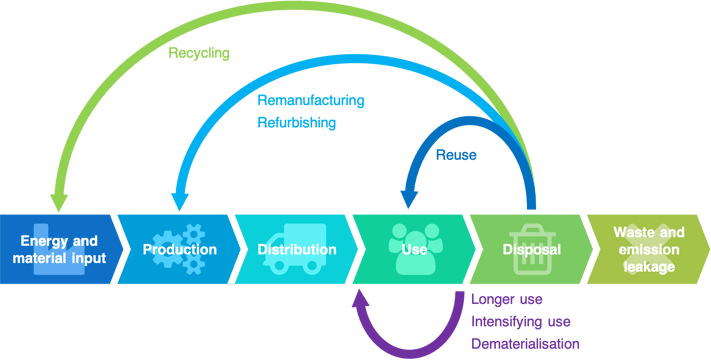
A circular economy, according to the Ellen MacArthur Foundation, one of the prominent and leading organisations of promoting the concept, is “based on the principles of designing out waste and pollution, keeping products and materials in use, and regenerating natural systems”. As opposed to the more widely used “take-make-waste” linear process in the manufacturing and service industries, the circular economy suggests a more closed-loop or regenerative system in which wastes in one industry can still be used as a resource for another. Circular Economy should not only include one industry to become effective, but rather considers a systemic approach by also involving policymakers and the community at-large.
Why is a Circular Economy Important?
One of the biggest and most threatening challenges that the world and its current generation is facing today is that of climate change. Largely because of the mismanagement of waste all around the globe such as carbon emissions, industrial wastes, and single-use plastics, the earth is rapidly reacting to these changes. Sea ices melt, sea levels rise, more intense heat waves are felt, and animal ecology are starting to shift. According to the United Nations, if, within ten years, this increasing trend of waste production continues, among other factors that affect climate change, we will not be able to reverse the irreparable damage we have done to our planet. The closed-loop concept which the circular economy proposes might be one major solution to this daunting challenge by rethinking and redesigning their products and processes from production to disposal.
Below are some examples of companies which started adapting systemic changes to pave the way in implementing regenerative design in their processes and business models.
- Nike
With the release of the Vapormax 2020 Flyknit mid this year, Nike has proved that sustainability can be achieved in creating products by using leftover materials, recycled polyester, recycled foam, and recycled Thermoplastic polyurethane. This is part of their effort to champion their goal of zero carbon and zero waste. Last 2018, it has also launched the Nike Circular Innovation Challenge wherein they invited people to come up with innovative and sustainable ways in creating products and processes using recycled materials recovered from used footwear and manufacturing scraps. The winner of Design with Grind, Yogo, was able to come up with yoga accessories out of Nike leftovers. In addition to their campaign on sustainability and design, they released a Circular Design Guide as a vast reference material to encourage people to rethink design in an innovative and sustainable manner.
- Dell
E-waste is also another material that we need to pay attention to. In a world that is highly digitally connected and reliant to technological products, management of electronic waste also poses a risk for the environment. In its effort to minimise their e-waste, Dell developed solutions such as having a closed-loop recycled plastic supply chain and using reclaimed carbon fibre source materials in manufacturing their products.
- Circos
From the production of textile to the manufacturing of ready-to-wear or tailored clothing, the fashion industry is also one of the top contributors to the generation of waste. Industrial wastes, especially from fast fashion companies, turn out to in waste water as well as our landfills. Circos, an online clothing rental subscription company, offers a solution in maternity and kids wear by allowing its customers to subscribe monthly to a range of designer wears and use the products up until it is time to change their subscribed sizes. At this point, the customers ship back the rented clothes and the company will clean, reuse or recycle the garments into something new.
- Biopak
Single-use plastics pose problems both in landfills and in water because of its non-biodegradable nature. Hundreds of cases have already been reported showing that marine life has already been affected because of this. To address this issue, Biopak offers a solution by providing a compostable alternative to food packaging. Using plant-based materials, Biopak not only manufactures compostable products, but also provides composting services to its customers to make sure that food wastes will contribute back to preserving healthy soils.
If there’s one thing that nature can teach us about this topic is that there is no such thing as waste. A plant grows into a tree and when the tree dies, it goes back to the earth and provides nutrients so that a new plant can grow again. If this kind of system can be applied to industries, especially in the manufacturing industry, wastes can be incredibly minimised. While several companies have implemented plastic-free policies and provide incentives to its customers for using reusable items or for helping them recycle old products, looking at fully adapting the circular economy goes beyond recycling and actually starts in product design as what the above companies have already started.
Envirotech Education is an Australian Registered Training organization (RTO) registered by the Australian Skill Quality Authority (ASQA) for delivery to domestic and international students and offers courses in Marine, Environment, Sustainability, Technology and much more.
